



What’s the TL;DR?
The flowers/cones of hops are commonly used in the NBE community due to their anecdotal success, though scientific papers on the topic are often controversial or inconclusive.
Its relevance to NBE lies in its content of 8-Prenylnaringenin (8-PN), the most potent phytoestrogen. However, the 8-PN content in hops may not be accessible to some people without the right gut microbiome or liver enzyme expression. Another phytoestrogen in hops, 6-PN, promotes healthy estrogen metabolism, similar to the supplement DIM.
Additionally, hops may have the capacity to stimulate prolactin production, although studies regarding this are inconclusive. Despite this, it is often cited as a galactagogue.
Dosage and timing
Most people in the NBE community use between 2000mg~3000mg of hops extract per day. However, it’s recommended that you start at the lowest possible dose and increase slowly.
Timing: Hops is used as a phytoestrogen, and therefore should only be used during the follicular phase. Hops can cause drowsiness, therefore it is recommended to take it in the evening.
In order to properly process hops into phytoestrogens, it is advised to take it with food (stomach acid is necessary), and to have a diet rich in the following:
- Inulin and high fiber: such as daily oatmeal, chia seeds, yellow onions, asparagus, and bananas
- Flavenoids such as rutin and quercetin: found in yellow onions, asparagus, green tea, or fruits such as citrus, berries, plums, peaches, grapes and apples.
You can also purchase and supplement inulin, rutin, and quercetin directly if needed.
Further details
Globally, hops (Humulus lupulus) is better known for its calming effects, which can improve sleep quality and overall relaxation, and for its use in beer. Active ingredients relevant to NBE are xanthohumol, isoxanthohumol, 8-PN, and 6-PN.
The problem with hops is that less than 1% of the compounds listed above are found in hops—and the content that does exist can rapidly degrade via oxidation.1 2 Different hops species exhibit different amounts of xanthohumol (the primary source of 8-PN), and xanthohumol content varies dramatically from one supplement to another.3
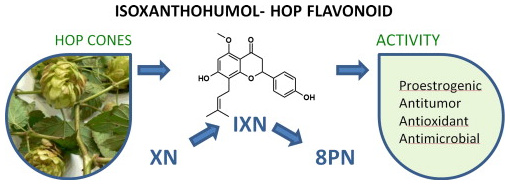
Furthermore, hops naturally contain very little 8-PN. Most of the 8-PN content must be converted, starting from xanthohumol (XN) to isoxanthohumol (IX) and then finally to 8-PN, the phytoestrogen.
XN can convert to IX via stomach acid,4 but in order to convert IX to 8-PN efficiently, intestinal bacteria populations of E. limosum and E. ramulus need to be elevated.5 Fiber and flavonoids as mentioned above both contribute to substantial microbiome populations within days,6 but diets heavily biased towards protein and saturated fats, and diets like ketogenic diets (high fat/protein), lower the population of these bacterial species.
While 8-PN is metabolized and inactivated within 2~6 hours in the human body,7 8 the 8-PN precursors have a long half life, nearing 20 hours, due to recirculation from the intestines.9 When XN and IX enter the bloodstream, they are excreted via bile, and this can get reabsorbed back into the bloodstream. Therefore, peak doses of these precursor compounds are reached 2~7h after dosing, and then rebound about 4~5 hours later.
Hops also contains the phytoestrogen 6-Prenylnaringenin (6-PN), this is produced within the plant and is readily available. 6-PN has been shown to be able to reset the estrogen receptor for re-use (a process called degradation). And has been shown to promote enzymes that influence estrogen metabolism to healthy, less carcinogenic, detoxification pathways similar to the supplement DIM.10 11
Available studies
Studies on the effectiveness of hops and 8-PN are extremely conflicting. The main reason for this is due to the fact that some animals do not respond to 8-PN at all, while others respond very well (mice vs rats for example).12
This is compounded by the fact that most studies are performed on uterine weight, whereas it has been found the 8-PN has a selective estrogen response (SERM) and has very little effect on the uterus, but profound effect on bone tissue,13 and has been shown to increase the number of terminal end buds in the mammary gland of rats.14
8-PN has a strong affinity for ERα, and less of an affinity for ERβ. It is the only known phytoestrogen to have an affinity bias for ERα.15 In relation to E2, it has a binding affinity of 20% for ERα and 7% for ERβ,16 and is able to compete strongly with E2 for the estrogen receptor.17
In humans
Fecal samples from female volunteers revealed that the fecal microbiota could be separated into high (8/51), moderate (11/51), and slow (32/51) IX converters, with a mean 8-PN production of 78%, 48%, and 6%, respectively.18 This highlights the importance of promoting a healthy gut microbiome.
A study with oral doses of up to 750mg, 8-PN was well tolerated by postmenopausal women. The pharmacokinetic profile of 8-PN was characterized by rapid and complete enteral absorption, high metabolic stability, pronounced recirculation and tight dose linearity, with a half-life of 1–3 hours and a rebound 4 hours later.19 This study estimates that 750mg of 8-PN is equivalent to 2mg E2. Note that it would be very difficult to reach equivalent doses via hops supplementation.
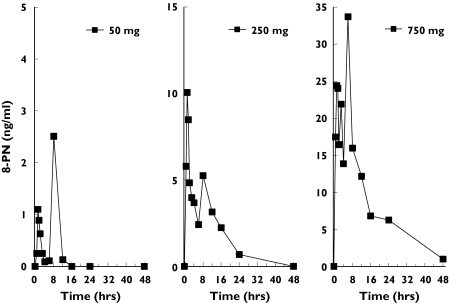
The same study found the 8-PN did not have an effect on LH until extremely high doses were reached. This effect was also found in rats at doses of 68.4 mg/kg/day.20
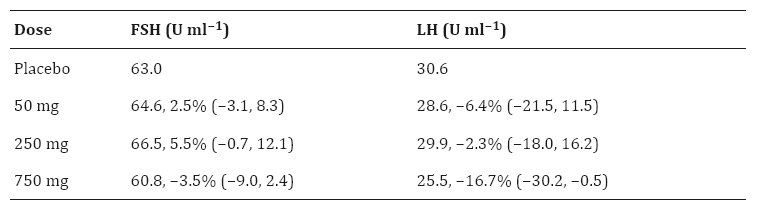
Note that 8-PN is rapidly metabolized in the human body by P450 enzymes to compounds 10x less estrogenic, and abundance of these enzymes in the liver may dramatically affect individual effective blood concentrations.21
A 2013 study performed on 21 women who were scheduled for a breast reduction analyzed the concentration of hops compounds in the breast tissue. For five days, they took 600mg per day of a hops supplement called MenoHop with confirmed daily doses of 6.3mg XN, 3.6mg IX, and 0.3mg 8-PN. 8-PN was detected in breast tissue only in those who were strong IX>8-PN converters. The study concluded that “low doses of prenylflavonoids (~10 mg/d) are unlikely to elicit ER-mediated responses in breast tissue relevant to breast carcinogenesis.”22
Further miscellaneous relevant studies:
- One study found isoxanthohumol content in non-alcoholic beer to be around 0.11mg/L.23
- A 2014 study found that xanthohumol may function as an anti-androgen.24
- Compared with young adults, people who live for longer than 100 years have, on average, 15 times more of the bacterium Eubacterium limosum in their gut.25
- Some animal evidence indicates that a polysaccharide in hops can increase serum prolactin. However, a small study in humans found that a hops soup appeared to lower serum prolactin levels.26
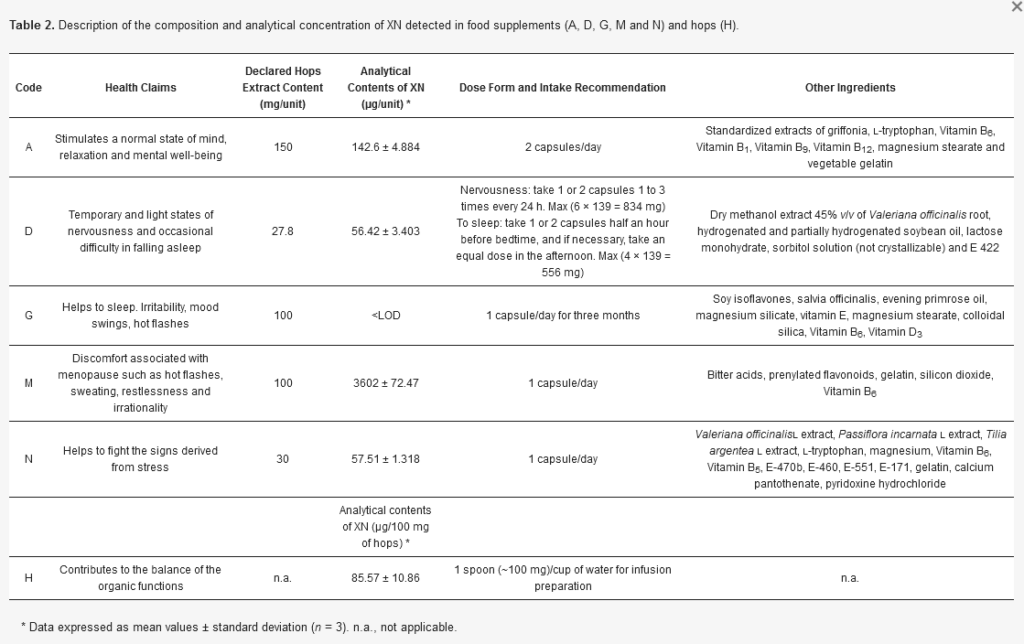
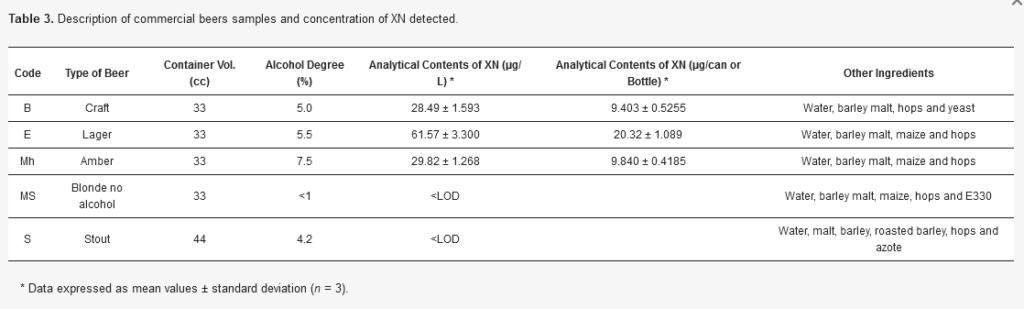
Below are tables from a study that examined the xanthohumol content in various supplements and beers.27 Note that the xanthohumol content varied wildly, and was consistently higher in supplements than beers.
Products to consider
The first product listed here is likely the product used in the study above that had the highest XN content (product M in the table above).

$18/30ct 100mg Meno-Dúo Hops extract – Estado Puro
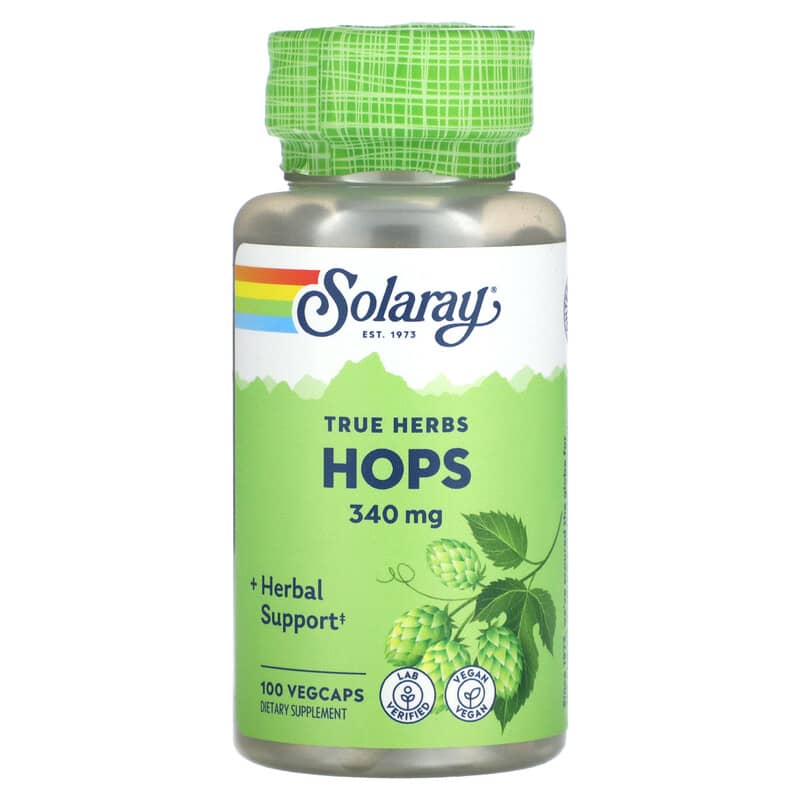

$19/250g Hops Extract – BulkSupplements
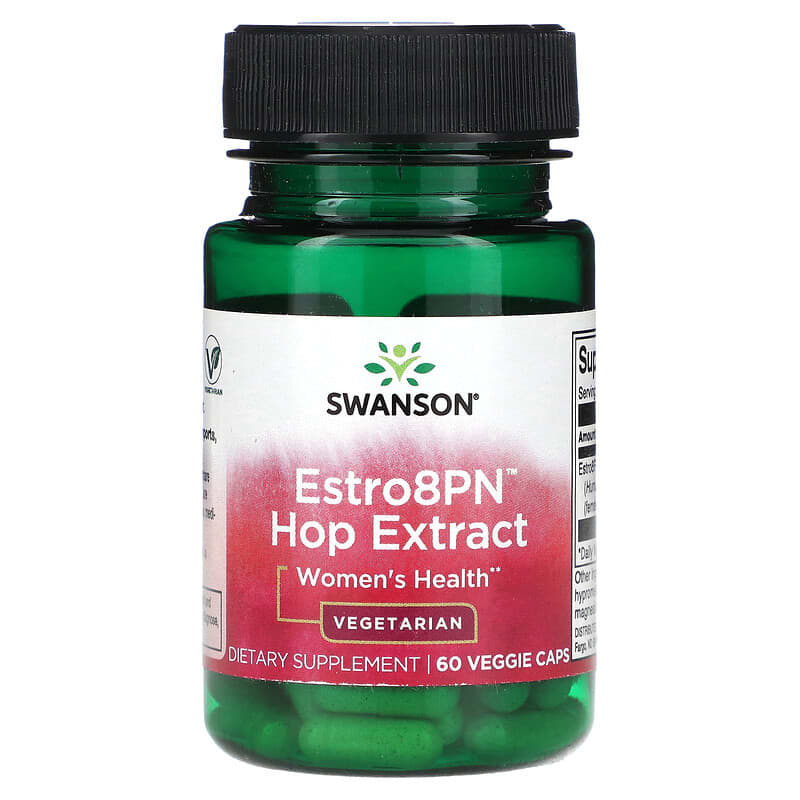
The following supplement focuses on 8-PN content:
Supplements focused on xanthohumol are also available:
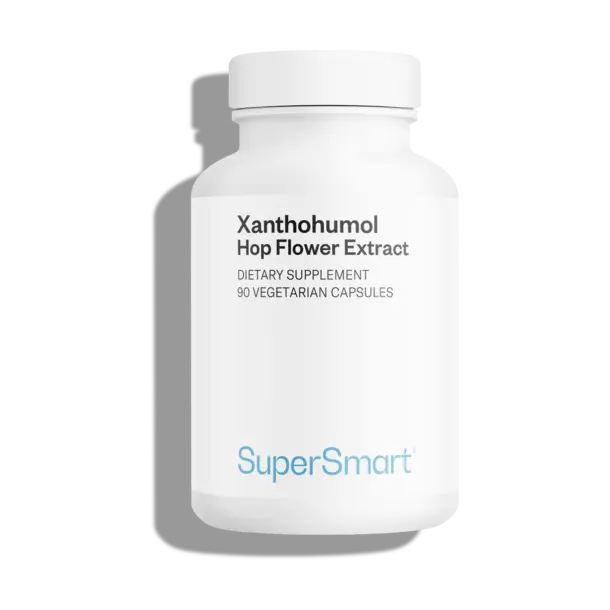
$34/90ct 5mg xanthohumol – Supersmart
References
- 100 YEARS OF HOP CHEMISTRY AND ITS RELEVANCE TO BREWING ↩︎
- Exploration of isoxanthohumol bioconversion using Eubacterium limosum ↩︎
- Determination of Xanthohumol in Hops, Food Supplements and Beers ↩︎
- Metabolism of xanthohumol and isoxanthohumol by human liver ↩︎
- Eubacterium limosum Activates Isoxanthohumol from Hops ↩︎
- The growth of Eubacterium ramulus is stimulated by dietary flavonoids ↩︎
- Estrogenic comparisons of red clover, hops, IX and 8-PN ↩︎
- Metabolism of 8-PN by human liver microsomes ↩︎
- Pharmacokinetics of Hop Phenols in Women Following Oral Administration ↩︎
- 6-PN from Hops Facilitates Estrogen Detoxification ↩︎
- Hop Extract and 6-PN Induce Estrogen 2-Hydroxylation ↩︎
- The Potent Phytoestrogen 8-Prenylnaringenin: A Friend or a Foe? ↩︎
- Tissue specificity of 8-prenylnaringenin: Bone vs Uterus ↩︎
- Assessment of the proliferative capacity of 8-PN in the rat mammary gland ↩︎
- The Potent Phytoestrogen 8-Prenylnaringenin: A Friend or a Foe? ↩︎
- Assessment of the proliferative capacity of 8-PN in the rat mammary gland ↩︎
- The endocrine activities of 8-PN and related hop flavonoids ↩︎
- The Potent Phytoestrogen 8-Prenylnaringenin: A Friend or a Foe? ↩︎
- Pharmacokinetics and systemic endocrine effects of 8-PN after single oral doses to postmenopausal women ↩︎
- Effects of 8-PN on rats after 3-month treatment ↩︎
- Identification of human enzymes involved in the metabolism of 8-PN and IX ↩︎
- Disposition of hop prenylflavonoids in human breast tissue ↩︎
- Isoxanthohumol–Biologically active hop flavonoid ↩︎
- Xanthohumol from hops is a novel antiandrogen ↩︎
- Through Ageing, and Beyond: Gut Microbiota and Inflammatory Status ↩︎
- Hops – Drugs and Lactation Database ↩︎
- Determination of Xanthohumol in Hops, Food Supplements and Beers ↩︎
